As winter's chill settles across northern latitudes, an ephemeral art form emerges from the interplay of human creativity and meteorological coincidence. The construction of snowmen, that most whimsical of cold-weather traditions, has evolved beyond carrot-nosed caricatures into sophisticated temporary sculptures exploring crystalline architecture. What begins as childhood play reveals profound connections to material science, structural engineering, and the very nature of water's solid state.
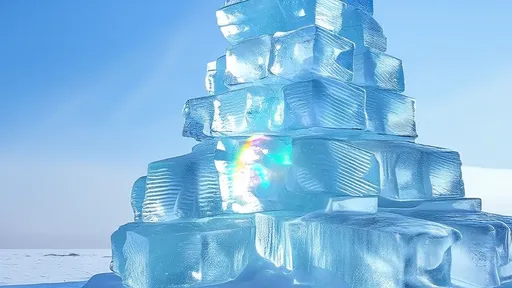
Recent exhibitions at winter festivals in Sapporo and Harbin have showcased snow sculptors employing principles of crystallography to create astonishingly complex formations. These aren't the simple three-ball figures of Christmas cards but intricate architectures featuring hexagonal symmetry, dendritic branching patterns, and carefully calculated load distributions. The artists, many with backgrounds in architecture or engineering, speak of "reading" snow conditions much like a stonemason assesses grain in marble.
The fundamental material science behind snow sculpture reveals why certain approaches succeed where others fail. Not all snow possesses the structural integrity for complex building. Temperature dictates crystal form: the iconic six-pointed dendrites form between -12°C and -16°C, while colder temperatures produce simpler hexagonal plates or columns. The ideal sculpting snow occurs at precisely -5°C—cold enough to maintain shape but warm enough for partial melting that creates crucial ice bridges between crystals through sintering.
Master sculptors have developed techniques that mirror ancient stoneworking methods. Rather than simply piling snow, they create compressed blocks using techniques similar to snow brick manufacturing. These blocks get carved using specialized tools—not just kitchen spatulas but custom-made heated blades, wire saws, and even dental instruments for fine detail work. The process resembles ice carving but demands greater urgency as the material remains perpetually close to its melting point.
Structural considerations dominate the planning phase of significant snow constructions. Unlike permanent buildings, snow structures face two opposing collapse mechanisms: plastic flow under excessive weight and sublimation or melting from solar radiation. Successful designs incorporate flying buttresses, arched openings, and strategic thinning that follows stress lines naturally. The most ambitious projects employ computational modeling to predict deformation over time, with some sculptures intentionally designed to evolve aesthetically as they sag and settle.
The temporal nature of these creations adds philosophical depth to the practice. Where architects build for centuries, snow sculptors work knowing their creation might last merely days or even hours. This acceptance of impermanence connects the practice to traditions like Tibetan sand mandalas or Japanese cherry blossom viewing. The eventual melting isn't failure but completion—the artwork's final phase as it returns to water and begins the hydrologic cycle anew.
Environmental factors introduce both constraints and creative opportunities. Sunlight direction dictates which surfaces melt fastest, requiring asymmetric designs that compensate for solar loading. Wind patterns get incorporated into ventilation schemes that prevent uneven melting. Some artists even use food coloring strategically placed to accelerate or retard melting in specific areas, effectively programming the sculpture's transformation over time.
Contemporary snow architecture has produced breathtaking examples of what's possible with frozen water. The annual Winter Carnival at Dartmouth College features snow sculptures reaching over 6 meters tall, with interior spaces large enough to host gatherings. In Finland, snow hotels complete with furniture and glassware carved from ice demonstrate functional possibilities. The most technically ambitious project to date might be the snow dome constructed in Quebec—a 10-meter wide unsupported span that stood for three weeks despite temperatures fluctuating above and below freezing.
The community of serious snow sculptors remains small but intensely dedicated. They share knowledge about snow compaction techniques, weather prediction for ideal carving conditions, and structural innovations through international competitions. What unites them isn't just technical skill but a particular mindset—the ability to think in four dimensions, anticipating how gravity and temperature will reshape their work hour by hour.
Educational institutions have begun recognizing the value of snow construction as teaching tools. Engineering programs use snow bridge competitions to demonstrate principles of load distribution. Materials science departments study snow crystal metamorphosis through sculptural experiments. Even mathematics departments employ snowflake formation to illustrate fractal geometry and exponential growth patterns.
As climate patterns shift, the future of snow sculpture faces uncertainty. Regions that historically relied on consistent winter conditions now experience unpredictable snowfall. This has prompted innovation in artificial snow production and preservation techniques, though purists argue machine-made snow lacks the structural qualities of natural snowfall. Some artists have begun incorporating climate commentary into their work, creating melting figures or using temperature sensors to trigger lighting effects that visualize environmental changes.
The humble snowman has come a long way from coal eyes and stick arms. Today's snow sculptures represent a fascinating convergence of art and science, tradition and innovation, permanence and transience. They stand as beautiful reminders that even the most temporary materials can support profound creativity—and that sometimes the most meaningful constructions are those we know will soon return to their elemental state.

By /Aug 27, 2025
By /Aug 27, 2025
By /Aug 27, 2025
By /Aug 27, 2025
By /Aug 27, 2025

By /Aug 27, 2025

By /Aug 27, 2025

By /Aug 27, 2025

By /Aug 27, 2025

By /Aug 27, 2025
By /Aug 27, 2025
By /Aug 27, 2025

By /Aug 27, 2025

By /Aug 27, 2025

By /Aug 27, 2025

By /Aug 27, 2025

By /Aug 27, 2025
By /Aug 27, 2025

By /Aug 27, 2025

By /Aug 27, 2025
